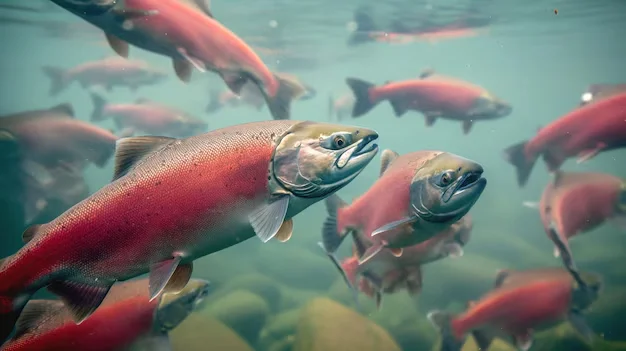
What really happens under the surface during salmon farming?
Food production
By Isla Blackhurst
Background
Norway is the largest producer of Salmon farming, producing “50%+ of global farmed salmon” (Agri Linkage, 2026). Salmon farming is the process of mimicking the natural salmon lifecycle. Salmon are hatched and placed in freshwater tanks, where they spend their first few months growing and biologically shifting to prepare their bodies to survive in saltwater, in a process called smoltification. After this transformation, salmon are transported to coastline net pens (large, open ocean cages) these pens are exposed to native wild salmon migrating nearby. Salmon will continue to grow in these pens, until they reach market size.
Key Issues
Coastline nets are having a devastating effect on wild salmon who migrate through the area. Salmon Open-net pens are often cramped, and the high density of fish can attract and increase the spread of diseases and parasites. These nets often interfere and block wild salmon’s critical migration routes, creating stress and potentially death.
Open-net pens create unnatural interactions between wild and farmed salmon, allowing diseases and parasites to be spread more easily. Farmed salmon often escape and interbreed with wild salmon, weakening genetics and producing offspring unfit for survival in the wild. Because of the amount of Diseases and parasites, chemicals such as antibiotics and pesticides, are being released excessively into the nets. These chemicals “can have unintended consequences for marine organisms and human health” (World Wildlife)
Concerns
One of the many concerns of the salmon open-net pens are how cramped salmon are inside, this density attracts parasites such as sea lice and nematodes (also known as roundworm) where they thrive and breed faster. These Sea lice are external parasites and can spread to wild salmon migrating nearby causing stress, tissue damage and potentially death.
Whilst Nematodes are internal parasites which live inside the salmons body and aren’t harmful to humans when properly cooked but are unappetising and raise healthy concerns over salmon farming. Research shows wild salmon that near sea cages have higher mortality rates and faster declines than wild salmon in other areas, this is a clear indication that Salmon farming has a negative impact on wild salmon in the area.
A solution
One possible solution is to move salmon farms away from critical, frequently used wild salmon migration routes. This would reduce interactions between farm and wild salmon, lowering the risk of parasites and diseases spreading, as well as lowering the risk of interbreeding. An enclosed system could maximise the effectiveness of this solution, while also keeping environmentally harmful chemicals from seeping into surrounding ecosystems.
Conclusion
In conclusion salmon farming has a negative impact on both wild salmon migrating in the area and the environment. These salmon farms can be placed along critical migration routes, causing stress and potentially death. The high density of these nets can increase the risk of disease and parasites, this affects wild salmon who are migrating nearby and come into contact. These negative impacts can be reduced by a simple solution, move salmon farms to an area away from critical wild salmon migration routes. Overall, the impacts of salmon farming need to be considered to protect wild salmon populations and declines.